





A follow-on to ‘The Interchange Shift’
In July we wrote that the Reserve Bank's interchange reform was not the end of loyalty in Australia. It was a transfer of loyalty funding from card issuers to merchants and we expected:
- smaller merchants would pocket interchange savings rather than invest in loyalty,
- big retailer’s programs (Everyday Rewards, Flybuys and OnePass), which were already paying interchange below the new caps, would capture more attention and spending as credit cards become costlier and less rewarding.
That was the right framing. But predictions are hard, especially about the future, so it was wrong. Big retailers have long benefited from interchange below the new caps in what were termed strategic rates, and we suspect the regulator expected that to continue. What our forecast missed is that the card schemes (Visa, EFTPOS and Mastercard) are taking this benefit away from the big retailers and strategic rates will cease.
On 1 October 2026, two things changed:
- The consumer credit interchange cap fell from 0.80 per cent to 0.30 per cent (Interchange, regulated by the RBA, is a fee set by the card schemes and paid by the merchant's bank to the cardholder's bank, the issuer, each time a card is used. It reaches the merchant as part of its merchant service fee, and it is what mainly funds card rewards).
- EFTPOS, Mastercard, Visa and American Express reintroduced surcharge bans on their cards (Surcharging is a separate matter: it is a merchant adding a fee at the checkout to pass the cost of accepting a card on to the customer. Whether a merchant may surcharge is governed by the contract they have with Visa and Mastercard).
The RBA estimated issuers (banks) would lose around $660 million a year in interchange revenue, and the merchant savings on consumer credit were widely quoted at $910 million.
Three things have happened since then.
- Issuers cut rewards,
- merchants did not receive the savings,
- and the card schemes quietly repriced the other half of their fee schedules upward, recovering much of the cut before it ever reached a merchant.
The money did not go to loyalty; it did not go to merchants; it did not move very far at all. It mostly stayed inside the payments system, with the banks that issue the cards and the schemes and acquirers that run it.
Nobody banned surcharging. No law bans it, and no regulator enforces it.
No-surcharge rules are terms in the commercial contracts between a card network and a merchant. In 2003, the Reserve Bank prohibited card networks from enforcing those terms, which is why Australian merchants have been able to surcharge for two decades. In March 2026, the RBA removed its own prohibition and said it expected the schemes to reinstate their rules promptly.
From 1 October, EFTPOS, Mastercard and Visa reinstated no-surcharge terms in their merchant agreements. American Express and UnionPay, which were never covered by the RBA prohibition in the same way, announced they would match.
The position today is that a merchant cannot surcharge because its contract with the scheme says it cannot. If a merchant surcharges anyway, the counterparty is the scheme, not the ACCC and not the RBA. Enforcement is contractual. Exceptions are a commercial decision for the scheme to make, on whatever terms it likes, for whichever merchants it chooses.
What the RBA modelled
The $660 million interchange savings figure deserves more scrutiny than it has received. It was the reduction claimed to offset the removal of surcharge income.
The RBA produced it by applying the new interchange caps to categories that were priced above those caps, while holding everything already below the caps, including the large merchants with strategic rates, constant. This was a risky assumption.
It was risky because the RBA Conclusions Paper noted that bank (issuer) revenue could also rise if the schemes chose to lift interchange fees currently sitting below the proposed caps, and it named strategic interchange rates paid by large merchants as the specific exposure.
The schemes have lifted strategic rates
Mastercard published an Australian domestic credit interchange schedule dated 30 September 2026, one day before the new caps commenced. It removes strategic interchange entirely. Every category previously priced below the cap moves to the cap. Visa has removed strategic rates on the same basis.
Strategic rates were not a minor concession to a handful of accounts. They covered the country's highest-volume merchants: major grocers, telecommunications carriers, large insurers, and government agencies. These merchants process the most card volume in Australia, and their interchange costs have gone up.
Interchange reform was presented as a cut. For the merchants with the most transactions, it is an increase.
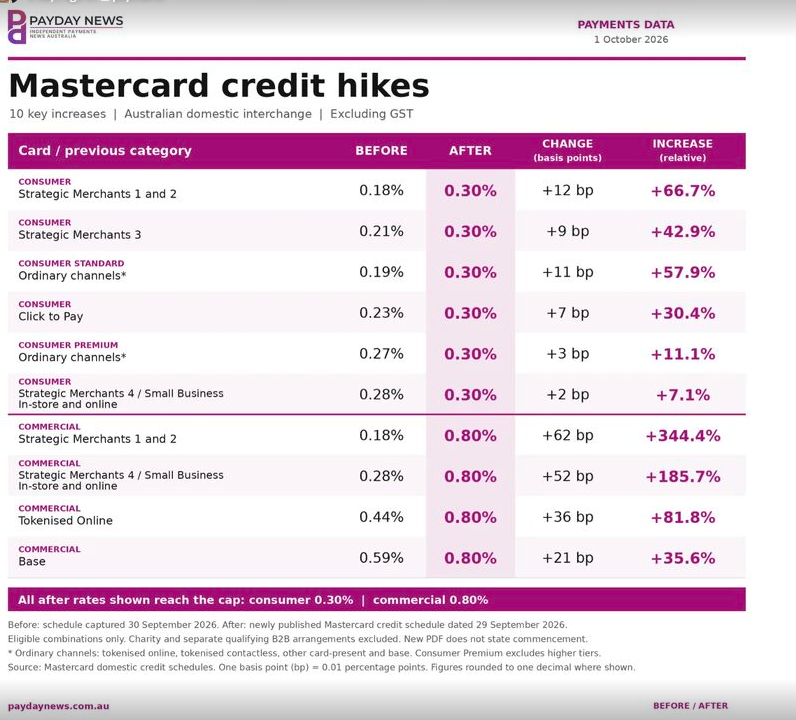
Sizing the clawback made by the schemes
Credit and charge card purchases on Australian-issued cards run at roughly $39.7 billion a month or about $476 billion a year. American Express sits outside this round of interchange regulation and accounts for perhaps 19% of that value, leaving around $386 billion on Visa and Mastercard.
Consumer credit cards
On consumer credit, the volume previously priced below the 0.30 per cent cap is substantial. Strategic merchants, standard ordinary channels, Click to Pay and consumer premium ordinary channels together plausibly account for 60% to 70 % of volume. The increases across those categories run from 2 to 12 basis points, concentrated in the larger categories at the higher end. A volume-weighted increase of around 9 basis points on roughly 65 per cent of $336 billion gives close to **$197 million a year**.
Commercial credit cards
On commercial credit, every rate moves to 0.80 per cent. Base at plus 21 basis points carries the most volume, tokenised online at plus 36 basis points is growing fastest, and the strategic categories at plus 52 to 62 basis points cover the largest accounts. A volume-weighted increase of around 30 basis points on $50 billion gives roughly **$150 million a year**.
Debit cards
Debit is harder to call. Purchases run at about $696 billion a year; the caps are being cut, and strategic rates have been removed on the same basis. Absolute rates are far lower, so the gross increase is smaller, and the net direction is ambiguous. Call it **$50 million to $120 million**.
The gross upward repricing is therefore in the order of **$430 million a year**, with a reasonable range of $300 million to $550 million.
The schemes recovered roughly 30 per cent of the consumer credit cut and turned commercial credit into a net increase.
And then it did not reach the merchant
Merchant Service Fees (MSFs) have stayed flat or risen since 1 October. Scheme fee and acquirer fee increases have absorbed what was left of the interchange reduction.
This matters enormously for how the loyalty market is funded, and it is the part of our July piece that we now withdraw. We wrote then that merchants would decide what to do with the freed margin, and that large retailers would reinvest while smaller ones banked the savings.
There is no freed margin.
The issuers cut anyway
The other end of the pipe closed on schedule.
Banks priced their program changes off the headline 0.30 per cent cap and the loss of the high-rate premium categories, and they executed before the strategic increases were published.
NAB moved a $100 gift card from 20,900 to 33,770 MyCard Rewards Points, a 62 per cent devaluation, and repriced its Virgin Money cards with higher annual fees and lower earn. ANZ cut the Frequent Flyer Black sign-up bonus from 130,000 points to 80,000 and removed the $200 cashback, with the Platinum bonus falling from 75,000 to 40,000. Commonwealth Bank closed most of its Awards transfer partners, leaving Velocity as the only remaining option.
None of that is being reversed. Issuers now recovering revenue through strategic rate increases are keeping it. No competitive pressure is forcing them to restore member value, and nobody is asking them to.
Issuers cut rewards, blamed a number that turned out to be too large, recovered part of the revenue by another route, and kept the difference.
The size of the Australian loyalty market
Ellipsis has tracked the size of the Australian loyalty market with a model originally built in 2019. That model sized the market at $8.0 billion of potential loyalty investment and $4.1 billion of actual, with credit cards accounting for 32% of actual spend. It forecast around 5% compound growth in a balanced scenario and it named "heavy regulation removing interchange entirely" as its downside case.
The forecast was close. Eight years at 5% would give $6.1 billion.
Our rebuilt estimate for FY26 is **$5.8 billion of actual loyalty investment**, against potential of around $10.5 billion. It considers the changes discussed above and a slight tightening of how much of top-line revenue retailers invest in loyalty.
Looking to FY30, our balanced case is now around **$6.6 billion at 3.3 per cent compound growth**, down from the 4.5% we would have forecast in July. The optimistic case reaches $7.0 billion. The pessimistic case, in which card-funded rewards keep contracting and Merchant Service Fees keep rising, is $6.0 billion.
The composition changes as card-funded loyalty falls from around a third of the market to the low twenties by FY30. What replaces it is retail media, now a $1.5 to $1.6 billion revenue pool in Australia and forecast to reach close to $3 billion by 2027, and paid subscription programs.
That is the real structural consequence. A large retailer with a retail media network and a subscription product can fund a loyalty program with its own data and members. A retailer with neither now faces payment costs that have not fallen and a card-funded earn proposition that is shrinking.
A daydream to finish up: the ATO
What follows is speculation, fantasy, not analysis.
On 1 October, the same day the new rules commenced, the Australian Taxation Office announced it will stop accepting credit card payments after 30 November 2026. It said that, as a government agency, it would not be appropriate to transfer the cost of merchant fees to the community. Unable to surcharge, the ATO would have to absorb those fees, so it is withdrawing the payment method instead.
The reaction has been sharp. The Australian Chamber of Commerce and Industry called it a staggering act of hypocrisy, pointing out that businesses are being told to absorb card costs while the agency enforcing their tax obligations declines to do the same. ACCI puts small businesses at 40 per cent of credit card payments to the ATO. The ATO's own figures say credit cards accounted for 2.3 per cent of tax payments in 2024-25, with more than 60 per cent of card payments coming from privately owned and wealthy groups, as well as public and multinational businesses.
A small business paying a BAS liability on a credit card gets up to 55 days before the money leaves the account. That is not a reward play; it is working capital.
The ATO is not prevented from surcharging by any law. It is prevented by the terms of its merchant agreements. Those terms belong to the schemes, and the schemes can vary them for any merchant they choose.
Any one of them could carve out an exemption. Not a general one. One, for the Australian Taxation Office. They could then recover the cost from only the taxpayers who choose to use a card.
The cost to any scheme granting the exemption is close to nothing. Whichever scheme moves first becomes, for at least a period, the only card the ATO accepts.
The volume is not trivial. If 2.3 per cent is measured by value against annual collections, the pool is in the order of $10 billion to $15 billion a year.
And the positioning writes itself. In a month when business groups are publicly accusing the tax office of hypocrisy, the scheme that solves the problem becomes the small business champion.
We will be watching to see whether anyone picks it up.
What to take from this
The lesson of the past three months is not that regulation damages loyalty. It is that the parties closest to the money adjust fastest.
The RBA identified the clawback risk in advance, named it precisely, and did not close it. The schemes repriced the day before commencement. The acquirers absorbed what was left. The issuers cut their programs against a number that turned out to be too big and kept the difference. The merchants, the intended beneficiaries, received very little, if anything.
For anyone running a loyalty program, the planning implication is simple. Do not build a business case on someone else's cost savings. Build it on funding you control: your own margin, your own media inventory, your own members' subscription fees. Those are the pools that didn't change owners this quarter.
The payments system moved around $430 million of interchange upward and roughly $470 million downward in the same week, and the net effect on the money available to reward customers was negative at both ends.
We are Ellipsis, The Loyalty Experts®. We help you find, understand, measure, manage and grow customer value. We’re here to help get in touch.
References
1. Reserve Bank of Australia, *Review of Merchant Card Payment Costs and Surcharging: Conclusions Paper*, March 2026. See in particular the Impact and Implementation chapter on the estimated $660 million reduction in issuer interchange revenue and the stated risk of networks raising below-cap rates, and the decision to remove the Bank's prohibition on scheme no-surcharge rules.
2. Reserve Bank of Australia, *Retail Payments Statistics*, data to July 2026.
3. Mastercard Australian domestic credit interchange schedule dated 30 September 2026, as reported by Payday News, 1 October 2026.
4. Australian Taxation Office, *ATO to stop accepting credit cards after 30 November 2026*, media release, 1 October 2026.
5. Australian Chamber of Commerce and Industry, press conference, Parliament House, Canberra, 1 October 2026.
6. Published program changes: NAB MyCard Rewards and Virgin Money Velocity card repricing; ANZ Frequent Flyer Black and Platinum changes; Commonwealth Bank Awards transfer partner closures.
7. Qantas Airways Limited, FY26 results and earnings call, 27 August 2026.
8. Morgan Stanley and IAB Australia retail media market estimates, 2025 and 2026.
9. Ellipsis & Co Australian loyalty market model, 2019 baseline and 2026 rebuild.