


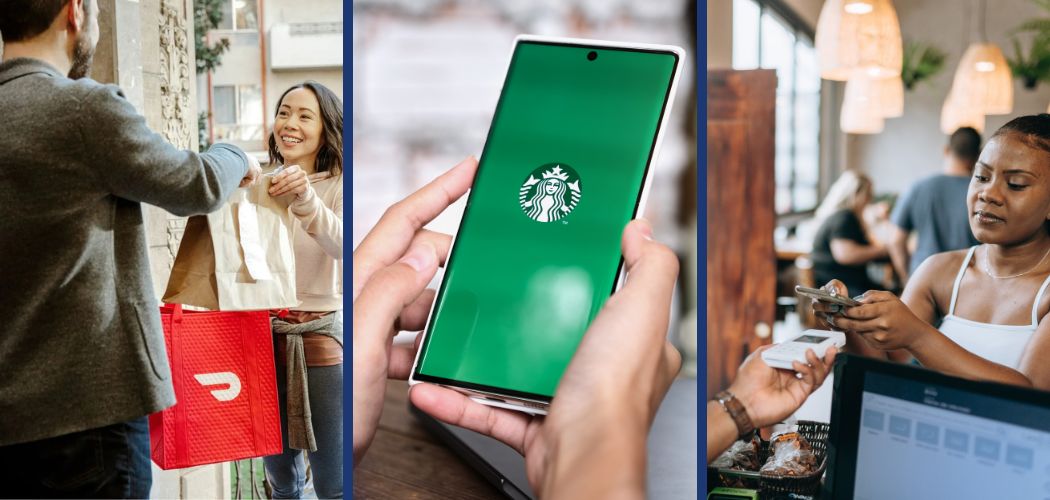

A driver signs up for the DoorDash platform and in the same flow receives a Visa debit card tied to Crimson, a banking and rewards product built specifically for gig workers. A Starbucks customer taps their phone at the register and, in a single motion, pays for their order, loads stored value onto their account, and earns Stars toward their next reward.
In both cases, the customer isn't using a loyalty program and a financial product. They're interacting with a brand that happens to provide both in the same experience. This is loyalty embedded finance, and it's a term that deserves exploration for anyone in the business of building sticky customer relationships.
Two definitions, Not one
Loyalty embedded finance is broadly defined as blending customer loyalty programmatic features with native banking and payment products into one seamless customer experience. Digging beyond that umbrella statement, brands can approach this emerging area impacting customer loyalty from two distinct starting points.
Loyalty-led embedded finance
- This describes a loyalty program that adds financial services — a wallet, a prepaid or debit instrument, buy-now-pay-later — to deepen engagement and give the program utility beyond points.
- The loyalty relationship comes first, while the financial product is the delivery mechanism, a value-added enhancement to the experience. Starbucks' in-app wallet is a clear example: the stored-value account and the rewards program are, for practical purposes, the same product.
Finance-led embedded loyalty flips the order.
- Here, a financial or platform product — a card, a banking app, a peer-to-peer payment vehicle for gig workers — adds loyalty mechanics to increase stickiness and reduce churn. The financial relationship comes first; loyalty is the retention layer built on top of it.
- DoorDash's Crimson program fits this model: the banking product is the platform, and rewards are another reason to stay.
Both of these qualify as "loyalty embedded finance", but they imply different owners inside an organization, different paths to execution, and different success metrics. That’s why it's worth making this distinction to create shared verbiage and understanding.
A related but more narrowly defining term is loyalty embedded payments, which refers specifically to rewards mechanics tied to the payment transaction itself. This includes card-linked offers, real-time point accrual at checkout, and closed-loop payment ecosystems.
Payments are a subset of finance; therefore we think of loyalty embedded finance as the broader category, encompassing payments as well as lending, deposit accounts, stored value, and even insurance products that carry loyalty value.
The part most marketers never see: the rails
Loyalty marketers should understand, at some level, that payments and loyalty are intricately linked. The ability to deliver a discount, an offer, or a point of recognition as part of the transaction itself is one of the most powerful moments in the customer experience. But there's a technical nuance underneath that moment that's worth exploring because it determines what's legitimately possible to build.
At checkout, the customer experiences one seamless transaction – and that is all they care about. Underneath, two separate technology paths (let’s call them “rails”) – at minimum, are running simultaneously:
- The payment rail handles authorization and clearing. This is the domain of Visa, Mastercard, or whichever network the merchant's processor uses, and
- The loyalty rail, which handles the discount, promotion, point accrual, or recognition tied to that same purchase.
These rails are owned by entirely different companies, integrated separately into the point of sale. The customer never sees the seam and doesn’t care as long as it works. But for anyone trying to build a loyalty product that performs well at checkout, understanding the seam is the whole game.
Three points of control worth understanding
The payment terminal. Devices from Verifone, Ingenico, and similar manufacturers are largely capture devices. Their role is to read the card, encrypt the data, and pass it along for authorization.
Modern terminals can run apps, but the terminal itself is rarely where the decision "does this customer get a loyalty discount" is made. It's the last mile of the payment rail, not the orchestration layer of business logic.
The e-POS software. Platforms like NCR, Oracle Micros, Aloha, Toast, and Shopify POS are the domain of most real-time loyalty scenarios. The POS software builds the basket, looks up the customer's loyalty identity, calls out to a loyalty or offer engine to calculate what applies, adjusts the final amount owed, and only then sends that amount to the payment terminal for authorization.
Loyalty logic resolves first; payment execution happens second. This means the retailer's choice of POS platform — and how open its APIs are — directly determines whether a loyalty program can operate at checkout in real time, or whether it's left waiting for the next redemption cycle.
A third path bypasses the POS entirely. Card-linked offer models — the approach pioneered by companies like Cardlytics and more recently by API providers like Fidel — match transactions after they settle, using data from the card network or issuer rather than the point of sale.
No POS integration is required, which makes this the workaround for retailers stuck with closed or outdated systems. The tradeoff is real-time capability: nothing happens in the moment of purchase, only after the fact, as a statement credit or retroactive reward.
For loyalty marketers, the practical implication is this: if the goal is a real-time, basket-aware experience at checkout, the integration hurdle is with the e-POS vendor, not the card network or the terminal manufacturer.
The payment rail is standardized and largely fixed. The e-POS layer is where flexibility — or its absence — lives, and it is also the most fragmented part of the stack since every POS vendor has its own approach to API maturity and third-party integration.
Why this matters today
The infrastructure enabling all of this is scaling quickly.
- Bain has estimated that embedded finance transaction value in the U.S. was on pace to exceed $7 trillion, more than 10% of total transaction value, by 2026 — up from under 5% just a few years earlier.
- Boston Consulting Group has sized the addressable embedded finance opportunity across the U.S., Canada, and Europe at roughly $185 billion, spanning payments, lending, accounts, and card issuance.
- And platforms that have embedded financial products into their core offering have reported revenue growth several times higher than those relying on subscription or commission models alone, according to research from payments infrastructure provider ConnectPay.
DoorDash Crimson is an example of an embedded finance partnership rather than a standard credit card play. Visa enables products like DoorDash Crimson through a combination of network licensing, real-time push-payment frameworks, and embedded fintech ecosystem integration.
In this case, DoorDash does not function as a bank. Instead, the accounts are legally opened through a partner institution—Starion Bank—under an official licensing agreement with Visa, ensuring the card is functional anywhere Visa debit is accepted worldwide. "Instant Deposit" capabilities are powered by a partnership with Astra's Payments Cloud running over Visa Direct and Mastercard Send.
The complexity that comes with the opportunity
Delighting customers through loyalty embedded payments products comes with a cost. Loyalty currency is increasingly behaving as a fiat currency and shifting from marketing expense to financial liability. Bond Brand Loyalty has estimated more than $100 billion in outstanding loyalty currency value sits globally and is tracked under revenue recognition standards like ASC 606 and IFRS 15.
Data moving across payment rails is subject to different regulatory scrutiny than data moving across marketing platforms and carries compliance exposure that pure marketing partnerships never did. This is a nuance to consider at the moment when a loyalty program touches financial infrastructure rather than sitting beside it.
The takeaway
"Loyalty embedded finance" isn't just a new buzzword or a simple trend to understand.
It’s likely to be the vehicle that delivers the future of customer loyalty as customers want to tap the utilities of payment, loyalty, and deals in one transaction, and in any channel where they shop.
There’s a complex technology layer that goes beyond the knowledge and maybe interest of most loyalty marketers. But it’s important to gain more cursory understanding of the possibilities as well as limitations to how loyalty embedded finance can impact the customer experience.
Knowing whether you're building loyalty into finance or finance into loyalty, and knowing which rail actually controls the moment of truth at checkout, is no longer a question you can leave entirely to your technical resource team. It's becoming a decision point in your strategic planning process for customer loyalty.