





New Mando and YouGov Research Released
Mando and YouGov have just launched the fourth edition of their "Understanding Loyalty in Europe" whitepaper. This latest research provides loyalty marketers across Europe with a comprehensive and up-to-date picture of loyalty engagement across the continent, covering programme membership, appeal and impact across 24 European markets. As with previous editions, the data is brought to life by a community of leading European loyalty experts who provide market-specific commentary, case studies and key predictions for 2026 and beyond, alongside deep dives into three of the hottest topics in loyalty marketing right now: gamification, partnerships and proving ROI.
The Research Highlights
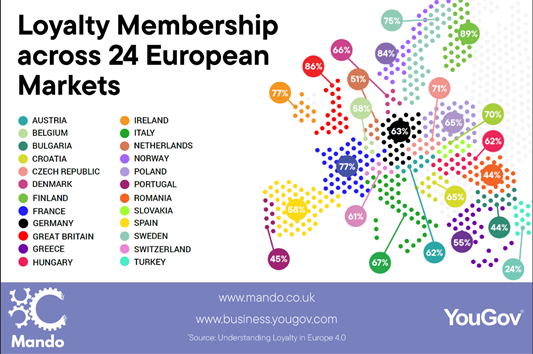
The headline finding is that loyalty programme membership across Europe now sits at 63.3%. The majority of adults in most markets are now members of at least one loyalty programme. This peaks in Finland (88.7%), Great Britain (86.1%) and Norway (83.8%), and remains lowest in Turkey (23.8%), Bulgaria (44.4%) and Romania (44.5%).
Programme appeal also continues to grow. 59.5% of adults across Europe now think loyalty programmes are a great way to reward customers, up from 55.4% in 2024. The British remain the biggest fans at 74.6%, followed by the Irish (72.4%), the Polish (69.3%) and the Germans (67.6%). At the other end of the scale, the Danish remain the least enthusiastic at 38.6%, alongside the Turkish (47.1%) and the Dutch (47.8%).
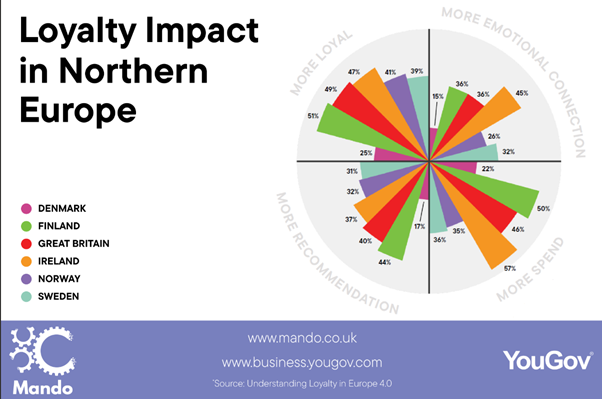
The research also investigates four key impact datapoints spanning transactional and emotional KPIs: impact on loyalty, spend, emotional connection and recommendation. In 2026, 41.9% of members say loyalty programmes make them more loyal, 35% say they spend more, 33.3% feel more emotionally connected and 34.5% are more likely to recommend a brand when a member of its programme. Whilst overall impact remains positive, the data reveals important nuances by market that are explored in detail in the paper.
Case Studies, Market Experts and Industry Deep Dives
Where this research really comes into its own is in the depth of expert commentary. The paper includes deep dive market case studies for Great Britain, Denmark, Sweden, Norway, Poland, Czech Republic, Hungary, Italy, Spain, Switzerland, Germany, France and the Netherlands, alongside two programme three industry topic discussions and two case studies from Miles & More and The Coca-Cola Company's new EU-wide loyalty programme, The Club.
3 Big Insights from the Research
1. Membership is growing but the engagement gap is widening
Across Europe, loyalty programme membership continues to rise but enrolment and active participation are increasingly different things. Markets like France (+4pts to 77%) and Germany (+3pts to 63%) are seeing membership climb, yet impact metrics are softening in both. France's loyalty expert, Michael Flacandji, describes a shift from active loyalty towards passive enrolment, while Germany's data shows a paradox of record high membership alongside a sharp decline in spend impact. The message is clear: getting consumers to join is no longer the hard part. Getting them to genuinely engage is.
2. Some markets are approaching saturation
With Finland at 89% and Great Britain at 86%, some markets are approaching the ceiling of what membership growth can achieve. Sweden has already seen total memberships decline as consumers strategically prune their loyalty portfolios, deepening engagement with a select few programmes rather than accumulating more. This concentration of wallet share trend is one of the most significant signals in this year's data and one that loyalty marketers in other maturing markets would do well to watch closely.
3. Emotional connection remains the big unlock
Perhaps the most consistent finding across all four editions of this research is that whilst programmes do a reasonable job of driving transactional behaviour, most still struggle to build genuine emotional connection. Only 33.3% of members across Europe report feeling more emotionally connected to a brand as a result of loyalty membership. Markets like Denmark where just 25% report increased loyalty despite 66% membership illustrate the challenge most starkly. The programmes highlighted as ones to watch in this paper, from Gail's in Britain to ICA Stammis in Sweden to Żappka in Poland, are those successfully bridging the gap between utility and emotion.
For more insights and a deep dive into all 24 European markets, download the full whitepaper here.