




When engagement plateaus, many programs turn towards adding experiential rewards as the saving solution. But we know that a stronger lever is the soft-benefit layer: the recognition, access, and behavior-triggered communications which tell a member that the brand truly knows who they are and their importance to them. Our recommendation: build that layer first, then amplify it with experiences.
The most durable loyalty programs have something that doesn’t show up in their earn rates or redemption catalogs. Their members feel the relationship, even in moments that don’t involve a reward.
We’ve always had a tool and exercises to help our CLMPs™ understand this but now Course 113, Fundamentals of Utilizing Soft Benefits, is dedicated to covering why the order of investment matters and how to get it right.
1. Experiences matter, but they’re easy to copy.
Let me first start with acknowledging that the shift toward experiences over the past decade was a reasonable response, and the results are now showing up in the data. Bond Brand Loyalty’s 2025 Loyalty Report, released with Visa, finds that “access” has emerged as the new primary driver of loyalty, and that the traditional value exchange of financial rewards, points and perks has been overtaken, while satisfaction is softening at the same time.
In the U.S., 48% of consumers are “very satisfied” with their program in 2025, down from 52% in Bond’s 2023 study. Yet only 1 in 3 Americans (33%) strongly agree that programs provide good value for money spent.
The gap is in what is being built. We’re seeing experiences that virtually any program, with a similar budget for it, can replicate. Customers have few choices that truly differentiate. We don’t seem to be asking ourselves if our reward catalog reflect our brand promise and seem content with having a general idea of what members might enjoy.
A grocery chain offering concert tickets to its top-tier members has added an experience, but it’s a generic one. A curated product introduction session with the chain’s head buyer, or even just early access to seasonal products, is much harder to be replicated by a competitor. And it ties closer to expressing what this brand specifically stands for.
2. One reward catalog can’t serve four different motivations.
In our Wiser Research U.S. consumer study (October 2025, 2,070 consumers) we identified four loyalty archetypes:
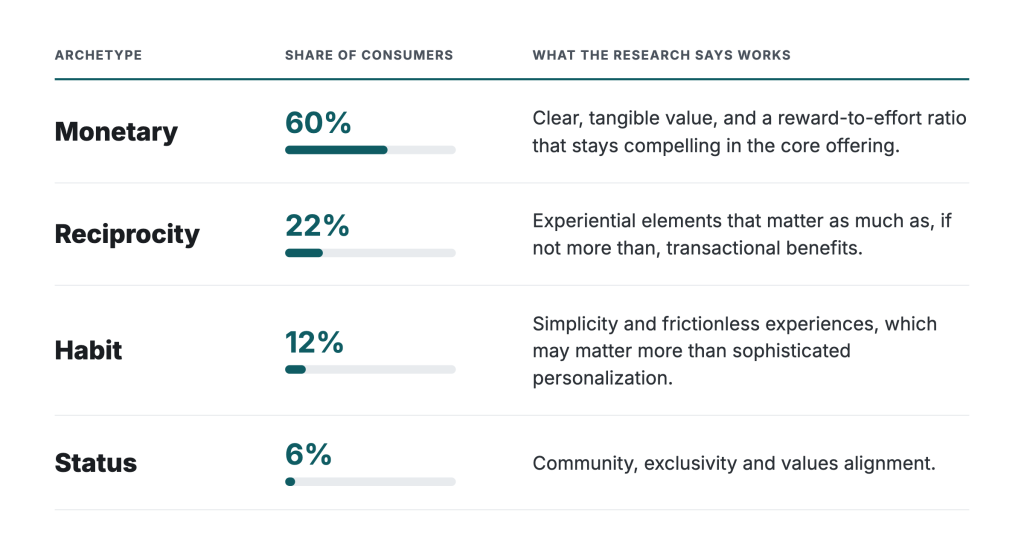
Our perspective is that each of these archetypes deserves a different brief.
- Monetary members are those that most programs are built for. These members mainly respond to prices, promotions and earning rewards. 58% rank “wanting to earn rewards” as their top reason for joining, against 53% overall. But they are only moderately loyal. 27% describe themselves as “very loyal” and 71% as “somewhat loyal,” so financial incentives can keep them, but competitors can also win them with better ones.
- Reciprocity members are the most positive group. 46% describe themselves as “very happy,” against 38% overall. Their switching triggers are quality and service: 15% cite quality issues, against 11% overall, and 10% cite customer service, against 6%.
- Habit members disengage early. 26% leave within three to six months, against 18% overall. They also respond less to personalization: 59% would engage more with personalized offers, against 65% overall.
- Status members carry the highest return potential. 52% describe themselves as “very loyal,” against 31% overall. They are also the fastest to leave once they stop feeling differentiated. Among those who disengage, 23% quit within 30 days, against 15% overall. Disengagement isn’t a program metric. It’s a revenue event, and for Status members it arrives early.
The practical implication is really quite simple. The same experiential catalog applied to all four archetypes is designed for one of them at best and possibly even none of them. Segment-aware rewards design isn’t a refinement; it’s a requirement to make the experience investment pay off.
3. Audit the soft-benefit architecture before you expand the catalog.
Soft benefits are the actions by the program that signal to members the nature of the relationship. They’re actions such as recognition at renewal, early access that isn’t in the terms and conditions, and a five-year member that gets treated differently from a new enrollee because the program design anticipated the difference in value from a tenured relationship.
Our data says these mechanics are the ones members respond to:
- 66% of shoppers rated a surprise earning opportunity as a top-five benefit they would use.
- A surprise benefit ranks first among the features customers would actively use, at 54%.
- And 55% said they would engage more if they could earn a specific status with tiered benefits.
And we’re not alone in personalized or curated rewards as a driver of the relationship. In Australia, For Love or Money 2026 report found that 63% of members believe programs have enough data to know them well enough to tailor offers, but only 40% say offers are always or often personalised.
McKinsey’s research puts consumer expectations at 71% for personalized interactions, with 76% disappointed when they don’t happen. Members will trade data for it: 69% would share data for personalized discounts, according to Publicis Sapient’s global customer loyalty survey, published August 2025.
The same Australian study found that “Reciprocity” (receiving free gifts, surprises or unexpected rewards) is among the two drivers with the most impact on member engagement.
How do I go about this then you ask?
Before adding experiences, think about answering these four questions:
- What recognition mechanics exist today in my program?
- How does the program treat a member’s fifth anniversary differently from their first?
- Which communications are triggered by behavior, rather than by the calendar?
- What access or status signals exist independent of any redemption action?
Your 90-day active rate - the share of new members who make a second transaction within three months - is the metric to start with.
- If it’s low then introducing the soft-benefits layer is where your work should begin.
- In the instances where you have strong answers to all four, then experiences will amplify soft-benefits.
- But where they’re thin, the experience layer tends to cost more than the returns its intended to drive.
So what
Members decide whether a relationship is real long before they redeem anything. Consider the cost of getting this wrong – it could be detrimental. We know from our research that 47% of shoppers recall joining a program and later disengaging. Of those who stopped, 62% said earning rewards was too long or hard, and 40% said the benefits weren’t appealing.
The programs that have cracked the relationship layer aren’t necessarily those with the most impressive or fullest catalogs. They’re those whose members feel the relationship in the interactions that don’t involve a reward at all.
Get More on Being Softer: Course 113, Fundamentals of Utilizing Soft Benefits, is one of 14 courses in the redesigned CLMP™ curriculum. Explore the full program or individual courses at LoyaltyAcademy.org.
Sources: Wiser Research, U.S. Customer Loyalty Insights Report (October 2025, n=2,070), pp. 4–7, 15; Wiser Research, Retail Insights Brief: Convenience & Fuel (Winter 2026, n=1,650), pp. 8–9; Wiser Research, Retail Insights Brief: Home Improvement (Winter 2026, n=796), pp. 9–10; Bond Brand Loyalty, The Bond Loyalty Report 2025 (with Visa), USA executive summary (fielded January–March 2025); Bond Brand Loyalty, The Bond Loyalty Report 2023 executive summary (52% of Americans "very satisfied"); Bond 2025 deck for Wiser Forums, slide 8 (48%); The Point of Loyalty, For Love or Money 2026, Australia (n=1,002); Publicis Sapient customer loyalty survey (published August 2025); McKinsey personalization research, as cited on McKinsey Brazil (2023).